What Is Hyperlocal Advertising?
Most advertising asks “how many people can we reach?” Hyperlocal advertising asks “which people, exactly where?”
A business usually serves a small area. A showroom draws customers from nearby neighbourhoods. A school draws families from a few kilometres around. A clinic draws patients who can reach it easily. Yet a lot of advertising is planned as if the whole city, or the whole country, were the audience.
Hyperlocal advertising starts from the opposite end: where your customers actually are.
What Is Hyperlocal Advertising?
Hyperlocal advertising means reaching an audience defined by a specific, narrow location, such as a neighbourhood, a residential community or a cluster of streets, rather than a whole city, state or broad demographic.
Instead of asking “who might be interested in this?”, a hyperlocal campaign asks “who is physically near enough to this business for the advertising to matter?”
How It Differs From Broad-Reach Advertising
A city-wide billboard or a broadly targeted social media campaign reaches a large, scattered audience. Many of those people may never be in a position to visit the business at all.
A hyperlocal campaign narrows the reach on purpose. It accepts fewer total impressions in exchange for a higher share of impressions that are actually relevant: people who live, work or spend time close enough for the business to be a realistic option.
| Broad-reach advertising | Hyperlocal advertising | |
|---|---|---|
| Audience | Large, spread across a wide area | Smaller, defined by a specific location |
| Main goal | Wide awareness | Relevant awareness among nearby people |
| Risk | Reaching many people who can’t realistically become customers | Reaching fewer people overall |
| Best suited for | Brands with a wide, dispersed customer base | Businesses whose customers come from a defined local area |
How Hyperlocal Advertising Connects to DOOH
DOOH advertising and hyperlocal advertising are closely related, but they are not the same thing.
- DOOH is a medium: advertising on digital screens in physical places.
- Hyperlocal is a targeting approach: reaching people within a narrow geographic area.
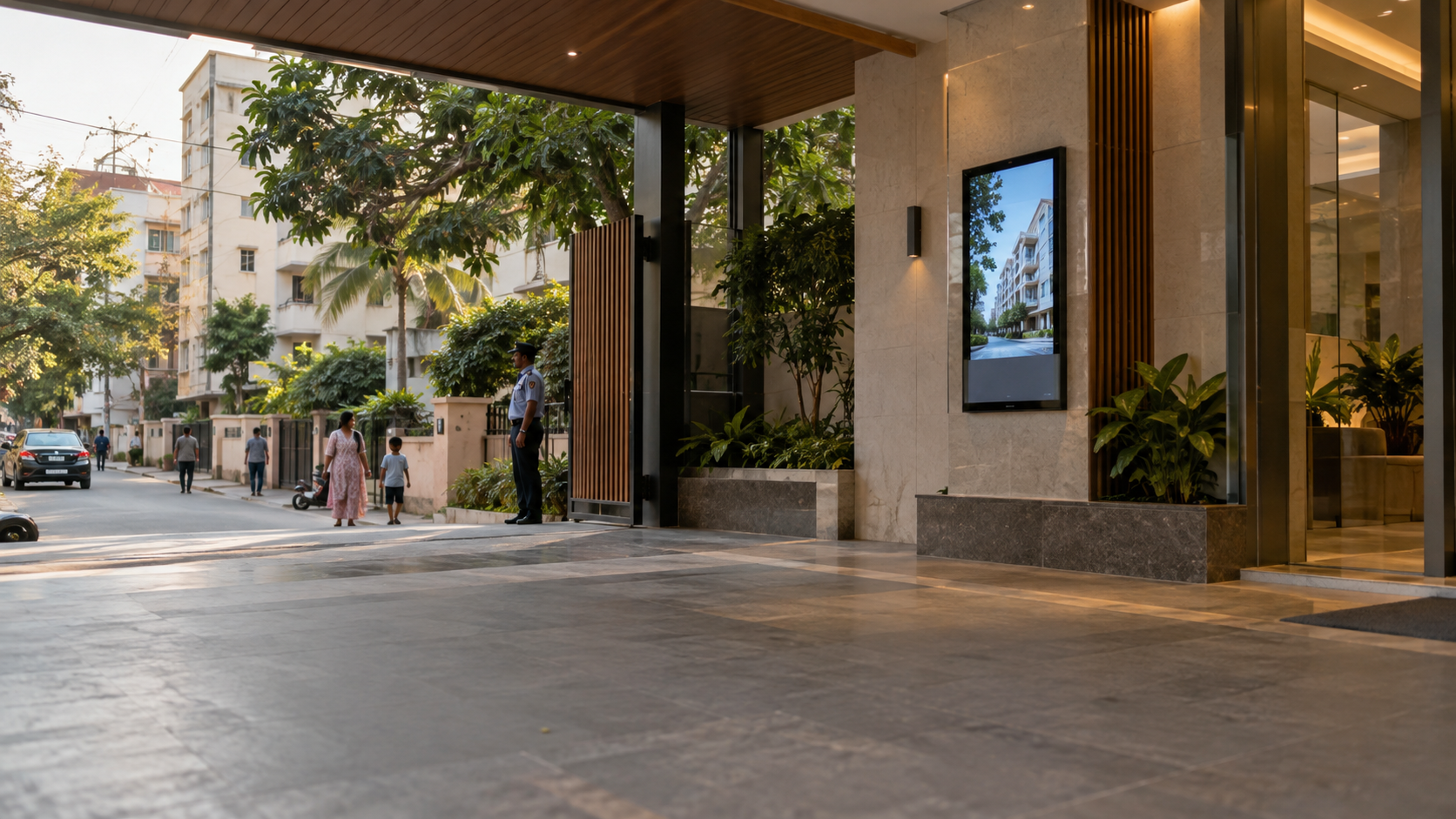
Placing a screen inside a specific residential community or restaurant is a hyperlocal placement by nature, because the audience is whoever is physically in that space.
DOOH is often used to deliver hyperlocal advertising. For how this compares with social media advertising, see our guide to DOOH vs Instagram ads.
Why Location-Specific Reach Matters
Not every business needs broad reach. If most of your customers come from a defined local area, advertising to people outside that area is spend that is unlikely to turn into visits.
A school, a diagnostic centre and a jewellery showroom each draw most of their real customers from a particular area, however widely their advertising reaches. Hyperlocal advertising lines up the reach of the campaign with the reach of the business itself.
A Practical Example: A Jewellery Showroom
A showroom in one part of a city has customers who live, dine and socialise in specific nearby neighbourhoods. A hyperlocal campaign doesn’t try to reach the whole city. It places the brand’s message in the restaurants, clubs and residential communities inside that realistic customer radius.
This does not guarantee a visit. It increases the chance that the people who see the message are people who could plausibly become customers.
A Practical Example: A School
A school’s realistic catchment is usually a defined set of neighbourhoods, not a whole city. City-wide advertising reaches many families who would never consider the commute.
A hyperlocal campaign puts screens inside relevant nearby residential communities, so the school’s message reaches families for whom it is a realistic option, often during the conversations where school choices are discussed at home.
What to Consider Before Running a Hyperlocal Campaign
- Define the actual radius. Start with where real customers or enquiries currently come from, not an assumed or aspirational area.
- Match the venue to the audience. A residential community, a restaurant and an office building within the same radius can still reach very different people.
- Keep the message local and specific. A hyperlocal ad can be more specific than a broad-reach ad, because it already knows its audience is nearby.
- Check what is actually measured. Hyperlocal reporting is usually venue- and location-based rather than individual-level. Ask what data a network can provide before assuming reach means interest.
Is Hyperlocal Advertising Right for Your Business?
The useful question is not “is hyperlocal good?” It is:
“Do most of our realistic customers already come from a specific, definable local area?”
If yes, a hyperlocal approach will likely use an advertising budget more efficiently than a broad-reach campaign covering areas the business can’t realistically serve. If your customer base is genuinely dispersed, or entirely online, broader channels may fit better.
Frequently Asked Questions
Is hyperlocal advertising the same as DOOH advertising?
Not exactly. DOOH is a medium (digital screens in physical places), while hyperlocal is a targeting approach (a narrow geographic area). DOOH is often used to deliver hyperlocal advertising, but the terms are not interchangeable.
How small is “hyperlocal”?
It depends on the business. For a single-location showroom or school it might mean a few kilometres. For a city-wide brand, it might mean running separate campaigns for individual neighbourhoods.
Can a large brand use hyperlocal advertising?
Yes. A city-wide or national brand can run neighbourhood-specific campaigns, for example around a new outlet opening or a location-specific promotion.
Does hyperlocal advertising replace broader campaigns?
Usually not. Many businesses use broad-reach advertising for general awareness and hyperlocal placements for the neighbourhoods where the decision actually gets made.
Start With Where Your Customers Are
Before choosing any screen or placement, map where your customers currently come from. That radius, not the number of screens available, should decide where you advertise.
Aira Konnect · Indoor advertising