
DOOH vs Instagram Ads: What’s the Difference?
Most businesses already run Instagram ads. Fewer have considered DOOH.
Both are valid advertising channels. They reach an audience differently, measure differently, and suit different kinds of business decisions.
This article compares the two on the points that actually matter before deciding where to put an advertising budget: where the ad appears, how much attention it gets, and what you can measure afterward.
What Instagram Ads Do
Instagram advertising works through a feed. A business targets an audience by demographic, location radius or interest data, and the advertisement appears among the posts a person is already scrolling through.
The strengths are clear: detailed targeting, granular reporting — impressions, clicks, cost-per-result — and the ability to adjust a campaign in real time based on performance data.
The tradeoff is attention. An Instagram ad competes with everything else in a feed built for fast scrolling. Most feed ads are seen for a second or two before a thumb moves on.
What DOOH Advertising Does
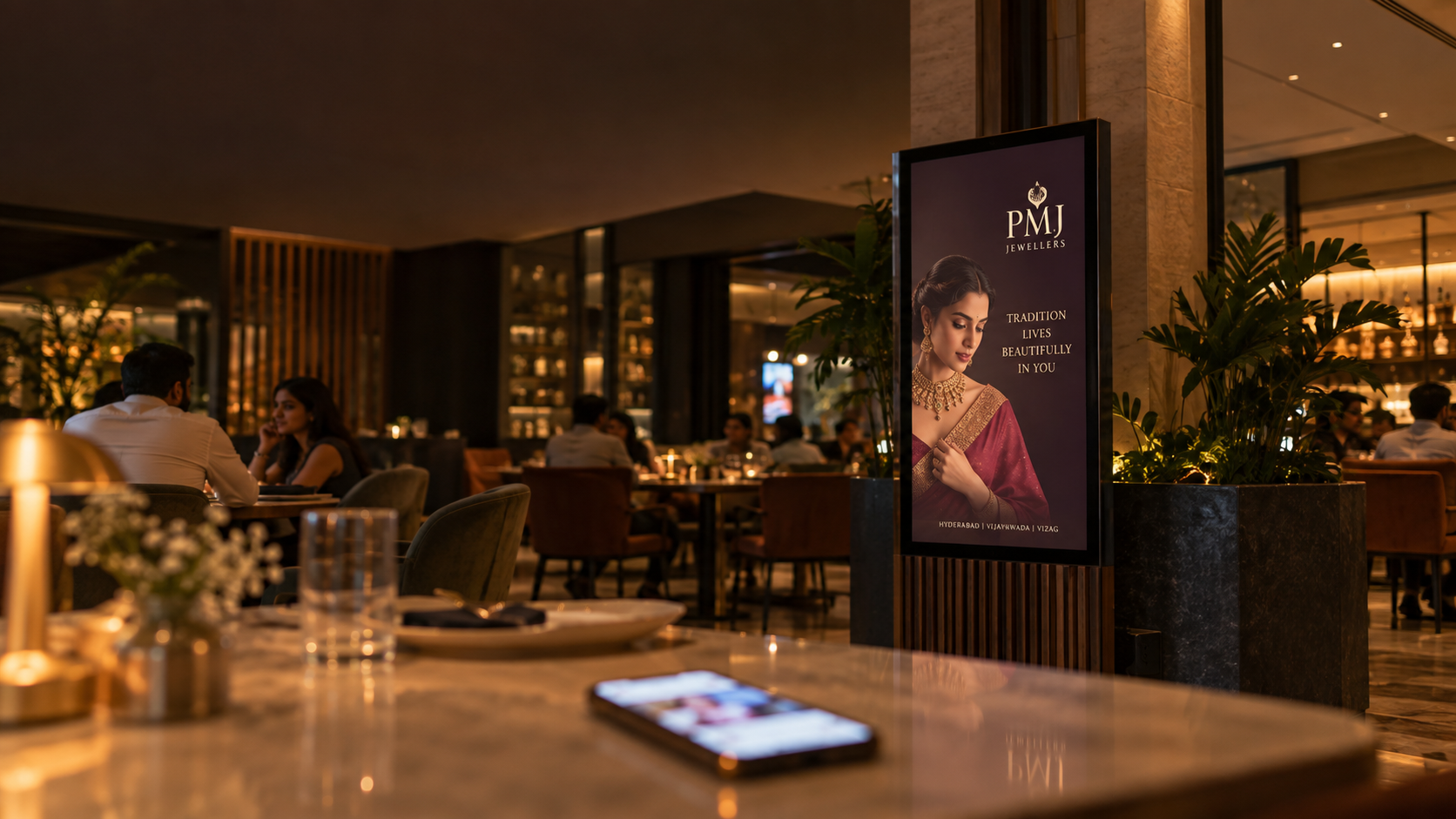
DOOH advertising places a message inside a physical space a person is already spending time in — a residential lobby, a restaurant, a club. There is no competing feed. The advertisement is part of the environment for as long as the person remains in it.
This tends to mean longer, less divided attention than a feed impression receives — though a screen showing an advertisement is not the same as someone noticing or remembering it. The advantage is contextual: the ad appears in a real place, at a moment when a person is not actively trying to avoid advertising the way they often are while scrolling.
A Practical Comparison
| Instagram Ads | DOOH Advertising | |
|---|---|---|
| Where it appears | Digital feed, alongside other content | Physical environment, without a competing feed |
| Attention | Brief, easily scrolled past | Sustained, tied to time spent in the space |
| Targeting | Demographic and interest-based | Location and venue-based |
| Measurement | Detailed digital metrics (clicks, CPM, conversions) | Venue-level reach and screen presence; less granular |
| Best suited for | Broad reach, retargeting, direct response | Local awareness, repeated visibility in a specific area |
Neither is universally better. The right choice depends on what a business is trying to achieve.
A Practical Example: Jewellery Advertising
A jewellery brand running an Instagram campaign for its wedding collection can reach a wide, precisely targeted audience — people of a certain age, in a certain city, who have shown interest in jewellery or weddings online.
But the decision of which showroom to visit is rarely made from a single ad impression. It is usually discussed over time, with family, often in person — at a restaurant, at home.
A screen in a relevant restaurant or residential community puts the brand’s name into that exact conversation.
The two channels are not in competition here. Instagram builds broad awareness; DOOH builds repeated, local presence in the places the actual decision gets discussed.
A Practical Example: Schools
A school’s Instagram ad about admissions can reach parents across a wide area who match a demographic profile. But most families narrow down school choices based on proximity and word of mouth — conversations that happen at home, well before an enquiry is made.
A screen inside a relevant residential community reaches that same household during the actual decision-making window, in a space the family already trusts.
When to Use Each — Or Both
A business trying to reach a wide, precisely defined audience quickly, with detailed performance data, will likely lean on Instagram.
A business whose customer decision is local, relationship-driven, or discussed over time — a showroom, a school, a restaurant, a clinic — may find that DOOH’s sustained, low-competition presence in the right neighbourhood does something an Instagram ad alone does not.
Many businesses use both: Instagram for broad digital reach and measurable performance, DOOH for repeated local visibility in the specific places their audience already spends time.
A Note on Measurement
DOOH reporting is venue-level: screen presence, location and reach estimates for that environment, rather than the click-by-click data Instagram provides. Any specific reach, footfall or performance figures shared with an advertiser should be confirmed against current, verified data — never estimated or assumed.
Frequently Asked Questions
Is DOOH more expensive than Instagram advertising?
Cost structures differ — Instagram is typically priced per impression or click; DOOH per venue and duration. A direct comparison depends on the specific campaign and should be checked against current rate information.
Can a business run both at the same time?
Yes. Many advertisers use Instagram for broad reach and DOOH for local, repeated visibility — the two serve different parts of the same decision process.
Which is better for a small, single-location business?
Often DOOH, since a single-location business depends heavily on its immediate neighbourhood recognising and trusting it — the exact audience hyperlocal DOOH reaches. More on this in our guide to hyperlocal advertising.
Does DOOH replace the need for social media advertising?
No — they serve different purposes. Most businesses benefit from using both rather than choosing one exclusively.
Considering Both Channels?
Instagram and DOOH are not competing choices — for many businesses, they work best side by side.
Aira Konnect · Indoor advertising